
Total internal reflection
Total internal reflection (TIRF) is an optical phenomenon. When light crosses materials with different refractive indices, the light beam will be bent at the boundary surface (Light Refraction). At a certain angle of incidence (the critical angle), the light will stop crossing the boundary but instead reflect back internally at the boundary surface. This occurs only at a high-Refractive Index/low-Refractive Index boundary, not the other way around. For example it will occur when passing from glass to air, but will not occur when passing from air to glass. (Source: Wikipedia)
In widefield microscopes and confocal microscopes this loss of high-angle rays reduces the effective Numerical Aperture of the objective, and therefore the resolution. (See Image Formation). This will happen in a Refractive Index Mismatch situation, which should be avoided during the image acquisition.
There is a type of microscopy called TIRF (Total Internal Reflection Fluorescence) microscopy that makes use of this phenomenon to image thin layers right at the boundary by using high-angle incidence illumination: only in this case the total internal reflection is a benefit. See Total internal reflection fluorescence microscope. TIRF deals mostly with 2D images. Huygens can handle 2D images by internally treating them as part of a 3D stack from which most planes happen to be missing. Strictly speaking Huygens does not generate TIRF Theoretical PSFs, but to deconvolve images from these microscopes, customers report good results with high NA confocal PSFs. Proceed by setting the Microscope type of your image to confocal and NA ~ 1.4.
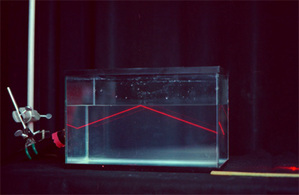
Image from Harvard University Natural Science Lecture Demonstrations